"Harlow Shapley (American Astronomer) -- Britannica Online Encyclopedia." Encyclopedia - Britannica Online Encyclopedia. Web. 18 May 2011. <http://www.britannica.com/EBchecked/topic/538693/Harlow-Shapley>.
"Harlow Shapley." NNDB: Tracking the Entire World. Soylent Communications, 2011. Web. 18 May 2011. <http://www.nndb.com/people/649/000167148/>.
Tenn, Joe. "The Bruce Medalists: Harlow Shapley." SSU Department of Physics & Astronomy - Home. Sonoma, 11 Aug. 2008. Web. 18 May 2011. <http://www.phys-astro.sonoma.edu/brucemedalists/Shapley/index.html>.
Wednesday, May 18, 2011

Harlow Shapley Biography
Early in his life, Harlow Shapley resolved to educate himself. Years later, as the director of the Harvard College Observatory, Shapley made education of the public an integral part of the Observatory's mission.
Harlow Shapley was born in Nashville, Missouri, on November 2, 1885. A twin, both Harlow and his brother Horace were named after their grandfathers. Shapley's father was a successful hay producer and dealer, and his childhood was spent on the family farm. He received much of his early education in a one-room schoolhouse. At the age of 16, Harlow took a course at a business school and became a newspaper reporter and city editor for the Daily Sun in Chanute, Kansas. He resolved to save his money and get an education. After attending the Carthage Collegiate Institute in Missouri, Shapley graduated as valedictorian of his class.
Shapley next entered the University of Missouri at Columbia, intent on studying journalism. After discovering that the journalism department wasn't yet open, Shapley took up astronomy instead. Later, Shapley would say that he had opened an alphabetical catalog of courses, found himself unable to pronounce archaeology, and so went on to astronomy. Astronomer Frederick Hanley Seares first got him interested in the study of stars. He earned his bachelor's degree in 1910 and his master's degree in 1911.
Shapley was awarded the Thaw fellowship of Princeton University and began studying as a doctoral candidate under Henry Norris Russell, who was the head of the astronomy department there. Russell's work involved using stellar spectra to determine the properties of stars and the orbits of spectroscopic binary, or double, stars. By 1913, Shapley had earned his Ph.D. His dissertation was entitled, "The Orbits of Eighty-Seven Eclipsing Binaries - a Summary." Shapley's thesis was a valuable contribution to the field of astronomy; it dealt with methods for determining the physical properties of eclipsing binary stars. Shapley became interested in determining the distances to these stars.
After traveling to Europe where he met many European astronomers, Shapley made a stop in Kansas City to marry his wife, Martha Betz Shapley, in April 1914. The same year, Harlow was offered and accepted a position at Mount Wilson Observatory in California. Martha assisted her husband in astronomical research at Mount Wilson and later at the Harvard College Observatory. She authored or co-authored numerous articles on eclipsing stars and other astronomical objects. Harlow and Martha had five children together: four sons and one daughter.
At Mount Wilson, Shapley studied Cepheid variable stars, using them as indicators of the distances of globular clusters. Within a year, Shapley realized that the Cepheid variable stars are not eclipsing binaries, but rather single pulsating stars. Their distances could be determined by measuring their apparent magnitudes, using Henrietta S. Leavitt's 1912 period-luminosity relationship to obtain their average brightness or average "absolute magnitude." Since pulsating Cepheid stars frequently occur in globular clusters, Shapley could use them to determine distances to the clusters. His greatest contribution to science came through his work in 1918, Shapley developed a new picture of the shape and size of the galaxy.
In April of 1920, Shapley participated in the Shapley-Curtis Debate in Washington, D.C. This "Great Debate" saw Shapley and Herber Curtis arguing over the scale of the universe, as well as the nature of nebulas and galaxies. Curtis argued that the Universe is made up of many galaxies similar to ours. Shapley argued that spiral nebulae were clouds of gas and that they and globular clusters occur within the Milky Way galaxy. Shapley argued against Curtis' position that the Sun was at the center of the galaxy, saying that our solar system exists in the outer limits of a very large galaxy. He was correct on this point, although Edwin Hubble played a part in proving Shapley's position about nebulae and globular clusters occurring within our galaxy wrong when he demonstrated that the Cepheid variables in the Andromeda galaxy were much further away than Shapley's proposed extent of the Milky Way and that Andromeda was indeed its own universe.
In 1921, Harlow Shapley became the director of the Harvard College Observatory to replace the deceased Edward Charles Pickering. Under his leadership, it became one of the world's most important centers for astronomy training and research. Shapley established the graduate school of astronomy as part of the educational structure of Harvard University. He was also responsible for mandating that public education be made a part of the Observatory's mission; a requirement for students in the Harvard program was lectures and presentations for school children. Shapley remained as the Observatory's director until 1952, and then continued research as the Paine Professor of Practical Astronomy until his retirement in 1956. After that, he continued his work as both a lecturer and an author.
During his time at the Harvard Observatory, Shapley was involved in many scientific societies, including the American Astronomical Society, the American Association for the Advancement of Science, and Sigma Xi. He also served on the committees that helped to found the National Science Foundation and UNESCO. A member of numerous academies and the recipient of many prestigious prizes, Harlow Shapley did much to help popularize the field of astronomy. He was active in the professional as well as political interests of science.
Harlow Shapley was born in Nashville, Missouri, on November 2, 1885. A twin, both Harlow and his brother Horace were named after their grandfathers. Shapley's father was a successful hay producer and dealer, and his childhood was spent on the family farm. He received much of his early education in a one-room schoolhouse. At the age of 16, Harlow took a course at a business school and became a newspaper reporter and city editor for the Daily Sun in Chanute, Kansas. He resolved to save his money and get an education. After attending the Carthage Collegiate Institute in Missouri, Shapley graduated as valedictorian of his class.
Shapley next entered the University of Missouri at Columbia, intent on studying journalism. After discovering that the journalism department wasn't yet open, Shapley took up astronomy instead. Later, Shapley would say that he had opened an alphabetical catalog of courses, found himself unable to pronounce archaeology, and so went on to astronomy. Astronomer Frederick Hanley Seares first got him interested in the study of stars. He earned his bachelor's degree in 1910 and his master's degree in 1911.
Shapley was awarded the Thaw fellowship of Princeton University and began studying as a doctoral candidate under Henry Norris Russell, who was the head of the astronomy department there. Russell's work involved using stellar spectra to determine the properties of stars and the orbits of spectroscopic binary, or double, stars. By 1913, Shapley had earned his Ph.D. His dissertation was entitled, "The Orbits of Eighty-Seven Eclipsing Binaries - a Summary." Shapley's thesis was a valuable contribution to the field of astronomy; it dealt with methods for determining the physical properties of eclipsing binary stars. Shapley became interested in determining the distances to these stars.
After traveling to Europe where he met many European astronomers, Shapley made a stop in Kansas City to marry his wife, Martha Betz Shapley, in April 1914. The same year, Harlow was offered and accepted a position at Mount Wilson Observatory in California. Martha assisted her husband in astronomical research at Mount Wilson and later at the Harvard College Observatory. She authored or co-authored numerous articles on eclipsing stars and other astronomical objects. Harlow and Martha had five children together: four sons and one daughter.
At Mount Wilson, Shapley studied Cepheid variable stars, using them as indicators of the distances of globular clusters. Within a year, Shapley realized that the Cepheid variable stars are not eclipsing binaries, but rather single pulsating stars. Their distances could be determined by measuring their apparent magnitudes, using Henrietta S. Leavitt's 1912 period-luminosity relationship to obtain their average brightness or average "absolute magnitude." Since pulsating Cepheid stars frequently occur in globular clusters, Shapley could use them to determine distances to the clusters. His greatest contribution to science came through his work in 1918, Shapley developed a new picture of the shape and size of the galaxy.
In April of 1920, Shapley participated in the Shapley-Curtis Debate in Washington, D.C. This "Great Debate" saw Shapley and Herber Curtis arguing over the scale of the universe, as well as the nature of nebulas and galaxies. Curtis argued that the Universe is made up of many galaxies similar to ours. Shapley argued that spiral nebulae were clouds of gas and that they and globular clusters occur within the Milky Way galaxy. Shapley argued against Curtis' position that the Sun was at the center of the galaxy, saying that our solar system exists in the outer limits of a very large galaxy. He was correct on this point, although Edwin Hubble played a part in proving Shapley's position about nebulae and globular clusters occurring within our galaxy wrong when he demonstrated that the Cepheid variables in the Andromeda galaxy were much further away than Shapley's proposed extent of the Milky Way and that Andromeda was indeed its own universe.
In 1921, Harlow Shapley became the director of the Harvard College Observatory to replace the deceased Edward Charles Pickering. Under his leadership, it became one of the world's most important centers for astronomy training and research. Shapley established the graduate school of astronomy as part of the educational structure of Harvard University. He was also responsible for mandating that public education be made a part of the Observatory's mission; a requirement for students in the Harvard program was lectures and presentations for school children. Shapley remained as the Observatory's director until 1952, and then continued research as the Paine Professor of Practical Astronomy until his retirement in 1956. After that, he continued his work as both a lecturer and an author.
During his time at the Harvard Observatory, Shapley was involved in many scientific societies, including the American Astronomical Society, the American Association for the Advancement of Science, and Sigma Xi. He also served on the committees that helped to found the National Science Foundation and UNESCO. A member of numerous academies and the recipient of many prestigious prizes, Harlow Shapley did much to help popularize the field of astronomy. He was active in the professional as well as political interests of science.
Thursday, May 12, 2011
Friday, May 6, 2011
APOD 4.6

Humanity's Expansion
This weeks APOD is fascinating in explaining the fact that humanity has many spacecraft that reach beyond where we can ever imagine going with ourselves. Among these spacecraft is one of the first exploration satellites sent up, Voyager 1, which is surprisingly moving fast, and will reach the edge of the solar system first, and will be the first object to explore the heliopause, and outside our home. It also talks of the New Horizons space craft, which is on its way to the Kuiper Belt, and is part of a new program on Zooniverse, where you can discover new objects for it to explore.
Friday, April 29, 2011
APOD 4.5

The Antennae
Looks like Corvus isn't good for nothing after all Mr. Percival. This great event makes for a stunning image, and can help explain a lot of possibilities when two galaxies collide. Apparently, the space between the stars in the galaxies has made it to where there have been almost no collisions of stars in the galaxies. However, there is so much collision of gas and dust that tons of new stars have formed from this episode. Also giving it its name, the two large projections of dust are due to gravitational effects and amazing physics. Love space!
Thursday, April 28, 2011
APOD 4.3
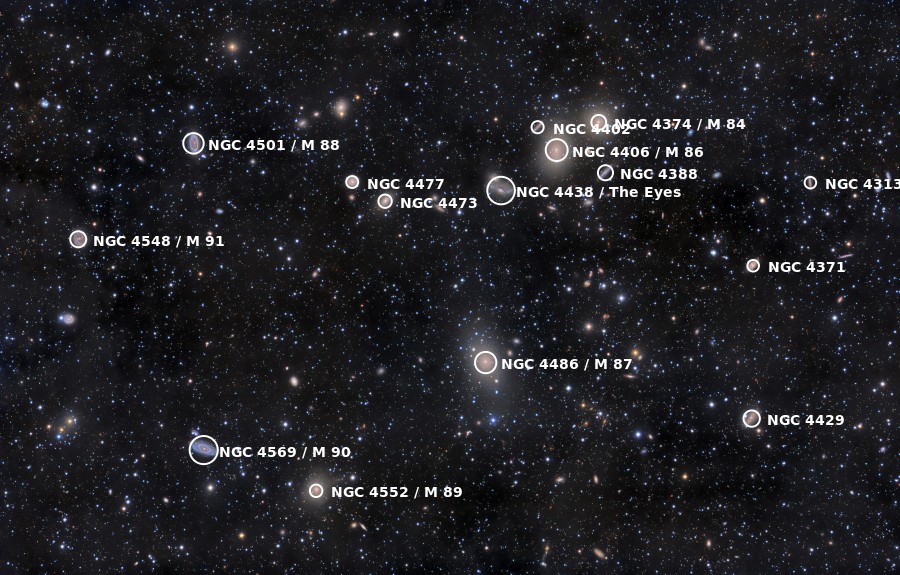
Virgo Cluster Galaxies
There are well over a thousand galaxies in this amazing cluster. The expanse of these galaxies, that is hard to take into perspective how many are actually there. We have barely explored our galaxy, yet there are thousands millions maybe billions or infinite more galaxies outside our own. We have far too much space to explore, I hope I get to see it all, but I guess I won't if the Republicans take over, and end up screwing up any chances I might have in the world. It is still a great photo, and lets me discover and object which I have never seen.
Monday, April 18, 2011
APOD 4.2

IC 140 is an stunning emission nebula in false color, and has some amazing shapes and gasses within it. The two tadpoles in the upper left are beautiful little globules of gas. They are kind of like a beautiful mark on what might lay out there for us to discover. The nebula surrounds a bright young star cluster, and might be a sign of ongoing star formation in the region. The tadpoles are about 10 light years long each. That is a far way, everything you see was ten years ago. This why it might be impossible for us to ever talk to each other when the human race ups and leaves each other.
Thursday, April 14, 2011
Tuesday, April 12, 2011
Zooniverse 3/31
I did about 2 hours of Solar Storm Watch. It was crazy awesome to see the amazing flares, but it is a ton of work.
Tuesday, April 5, 2011
Zooniverse 4/5
I spent about 2 hours today on Moon Zoo doing Boulder Wars. It gets very monotonous after a while, and there are some photos that are just black, but it is cool looking at all the crazy pictures of the moon.
Zooniverse 3/31
I did about 2 hours of Solar Storm Watch. It was crazy awesome to see the amazing flares, but it is a ton of work.
Thursday, March 31, 2011
APOD 4.1

Mercury from Messenger
Mercury, looks quite like the moon. A lot like the moon actually, but it is larger, denser, and more massive and has twice the gravity of the Moon. What I am truly interested in is the fact that we made a satellite so resistant to heat that it could get all the way to Mercury and not burn up. Without an atmosphere, planets really get pummeled. These craters have these awesome blue shades coming out of them and brown patches, and it makes me wonder what it truly is. The large crater at the upper left hand corner is actually 50 miles wide. Holy ridiculousness Batman, a 50 mile wide crater. I guess the sun's effect on comets really affords this planet a beating. Awesome planet, awesome APOD.
Monday, March 28, 2011
APOD 3.8

Valles Marineris
Mars, my favorite planet. It reminds me of Tatooine in a way. But in all reality, Earth's Grand Canyon is one of my favorite places I've ever visited, and simply put, this thing trumps it. I don't even know if this deserves to be called a canyon. It is so massive that it is more just a low point on the big red planet, rather than a canyon. It is said to be up to 8 meters deep, which means it could have even been an great place for an ocean, but what do my ideas present? The true origin is thought to be a giant crack that occurred when the planet was cooling.
APOD 3.7

NGC 6914 Nebulae
This beautiful amount of dust in the sky is amazing. Now this is clearly false color, but who cares NASA. They make beautiful images using the spectroscopic findings and then color them all in. I wish I could have pulled this off when I was 3. This is a star factory, among emission nebulae. The red is a hot hydrogen, and it looks great in false color. You know all these pictures aren't as cool as I give them credit for. When you actually look up at the sky, you see shades of blue, from stars, grays, and blacks, and the occasional whites. It is actually quite disheartening and quite a dream crusher. Oh well, still makes for some awesome backgrounds.
Thursday, March 3, 2011
APOD 3.6

California Nebula
NGC 1499 has quite a resemblance to the outline of the state of California, is found within Orion's Arm. What is amazing to hear is, so are we. This nebula is only 1500 light years away. That is simply nothing compared to the distances of many other objects. The nebula has a reddish tint to it due to Hydrogen colliding and bonding with "long lost" electrons. The entire thing is only about 100 light years long. Not a bad picture for such a small object. The culprit of the nebula being emission is expected to be the bright XI Persei emitting its electrons making this a beautiful object. This can actually be seen quite easily with a wide view telescope, therefore I know what I will be asking to see at the next star gaze.
Sunday, February 27, 2011
Henry Norris Russell Essay 3
Henry Norris Russell was born on October 25, 1877, in Oyster Bay, New York. He received the majority of his education at Princeton. He graduated in 1897 with the highest standing of a Princeton student ever. During his time he was considered the best American astronomer, and his discoveries and awards exemplified that thought.
"A man of overflowing energy, never sparing himself in his own work or in assisting the researches of others, he was the most eminent and versatile theoretical astrophysicist in the United States if not in the world." was used to describe Russell on an obituary by Colonel Stratton.
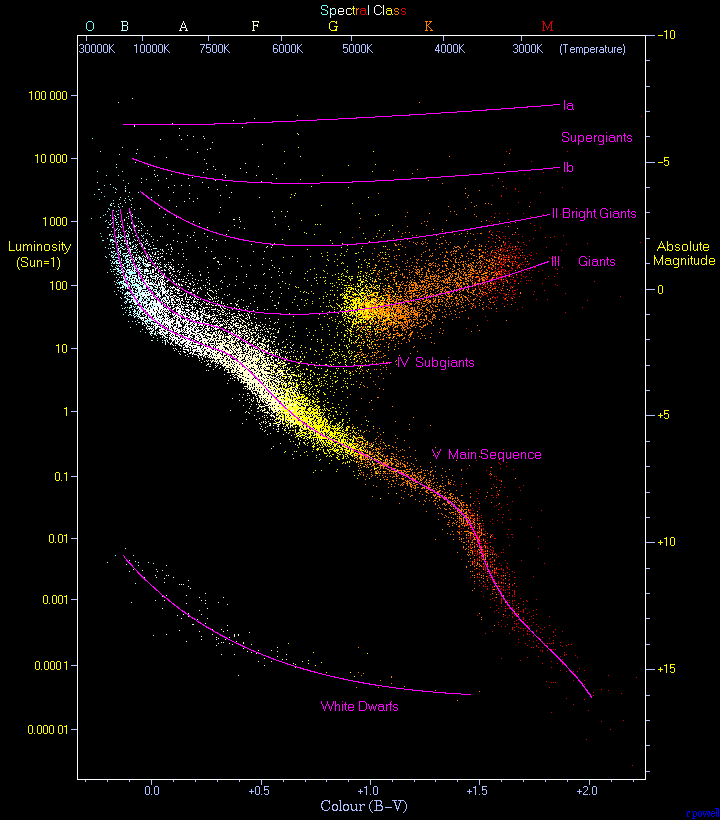
Some of his most amazing contributions were the color magnitude diagram, eclipsing binary theory and calculations, spectrum analysis, discovering the mass of stars, and the popularization of astronomy at a high level. But, Russell also made great contributions to solar and stellar composition and constitution, the origin of the planets and comets, characteristics of planetary atmospheres, the contacts of religion of science, and consulting on all astronomical and spectroscopic problems. The man wrote over 200 technical papers, and his contributions were all around simply amazing to everything studied nowadays. Colonel Stratton was right in saying that Russell was a man of unequaled versatility.
Working apart from Ejnar Hertzsprung, Russell demonstrated the relationship between types of stars and their absolute magnitude. He then collaborated with Hertzsprung to create the Hertzsprung-Russell Diagrams. This H-R diagram mainly traced the placing of the main sequence stars, giants and dwarfs.
 Working with Frederick Saunders, he developed Russell-Saunders coupling which is also known as LS coupling. This is not nearly astronomical, but shows the true range of his studies, and the powers of ten. Russell was an great man and astronomer and without his contributions the field of astronomy wouldn't be anywhere on the map.
"A man of overflowing energy, never sparing himself in his own work or in assisting the researches of others, he was the most eminent and versatile theoretical astrophysicist in the United States if not in the world." was used to describe Russell on an obituary by Colonel Stratton.
Some of his most amazing contributions were the color magnitude diagram, eclipsing binary theory and calculations, spectrum analysis, discovering the mass of stars, and the popularization of astronomy at a high level. But, Russell also made great contributions to solar and stellar composition and constitution, the origin of the planets and comets, characteristics of planetary atmospheres, the contacts of religion of science, and consulting on all astronomical and spectroscopic problems. The man wrote over 200 technical papers, and his contributions were all around simply amazing to everything studied nowadays. Colonel Stratton was right in saying that Russell was a man of unequaled versatility.
Working apart from Ejnar Hertzsprung, Russell demonstrated the relationship between types of stars and their absolute magnitude. He then collaborated with Hertzsprung to create the Hertzsprung-Russell Diagrams. This H-R diagram mainly traced the placing of the main sequence stars, giants and dwarfs.
Tuesday, February 22, 2011
Henry Norris Russel Sources
"Henry N. Russell Definition of Henry N. Russell in the Free Online Encyclopedia." The Free Encyclopedia. Farlex. Web. 22 Feb. 2011. <http://encyclopedia2.thefreedictionary.com/Henry N. Russell>.
"Henry N Russell, Henry N Russell Science Definition | Science Dictionary." Dictionary.com. Ask.com. Web. 22 Feb. 2011. <http://dictionary.reference.com/science/henry n russell>.
Shapley, Harlow. "Henry Norris Russel." National Academy of Sciences (1958). Print.
"Henry N Russell, Henry N Russell Science Definition | Science Dictionary." Dictionary.com. Ask.com. Web. 22 Feb. 2011. <http://dictionary.reference.com/science/henry n russell>.
Shapley, Harlow. "Henry Norris Russel." National Academy of Sciences (1958). Print.
Friday, February 18, 2011
APOD 3.5

X-Factor
This picture was taken on Monday, February 14th 2011. Whats better than a bunch of roses for Valentine's day? The Sun has the answer. An X-class flare is what we all of humanity likes. This is like the dawning of the age of Aquarius for solar astronomers. An X-class flare is a massive solar flare, one that has not been seen for quite some time. The flare was so bright that it distorted the pixels of the image from overflow. This X-class flare caused an coronal mass ejection. What none of these sites or the APOD explained was that if there is a possibility for a flare of this magnitude to damage or effect Earth, other than in some killer Aurora. Anyways, this flare is the courier for a much welcomed solar maximum, which will mean even more ejections and flares. The solar maximum also peaks around 2012...
Friday, February 4, 2011
APOD 3.3

The Whirlpool Galaxy, M51
An extremely beautiful sight to see in infrared. This is the perfect time for this APOD to come along as we are studying interstellar medium. This photo is shopped to dissipate the glare of the massive amounts of stars withing the galaxy, but it still is a behemoth of doom. The extremely large and swirly galaxy is only about 15,000 light years across, no big deal, but its shape and pronounced swirls are the most interesting part. The reason the image was taken was to explore how the galaxy forms stars. The interstellar medium we are studying definitely pertains to the giant laboratory that this galaxy is. This is a beautiful sight, but I wish we could explore it more.
Friday, January 28, 2011
APOD 3.2

Tarantula Nebula
Yes, on my blog I cover a lot of nebula and space dust, but it is all so beautiful and interesting. I do in fact know that they all come from coloration, but they are still stunning to view without the luminous colors. The sheer mass and size of this nebula is ridonculous. It is nearly 1,500 light years across. We aren't even a cell in this massive universe. How is anything or anybody even aware of our existence if everything is so spaced out, but more about the nebula. The nebula is a star forming region that is located within this large Magellianic cloud, and the whole thing revolves around our Milky Way. If the nebula was placed as close as the Orion nebula, it would command 30 degrees of the sky, you know, only 60 full moons worth. This is a spectacular sight and this is why I love ASTRO.
Subscribe to:
Posts (Atom)